





The best ergonomic office chair in South Africa for most desk workers: a Pro Flow buyer's guide
Most people searching for the best ergonomic office chair are looking for the same thing: a chair that genuinely supports their back across a full workday, adjusts to fit their body properly, and doesn't cost the same as a return flight to Europe.

The Pro Flow Ergonomic Chair from Workspace Dreams is the answer to that search for the majority of South African desk workers. It's the best-selling chair in the range for a specific reason: it covers everything most people actually need for a 6–8 hour workday, at a price that makes genuine ergonomic support accessible without compromise.
This guide explains what makes the Pro Flow worth its position as South Africa's most popular ergonomic office chair, what each of its features actually does for your body, and who it's genuinely the right chair for.
What the best ergonomic office chair needs to do
Before getting to the product itself, it's worth being clear on the criteria. The label "ergonomic" gets applied to virtually every chair on the market, including basic task chairs with minimal adjustability and no genuine postural support. The word has been stretched so far that it barely means anything anymore.

For a chair to genuinely support a 6–8 hour workday, it needs to do the following things well.
The Pro Flow ticks every one of these boxes. Here's how.
Our top pick: the Pro Flow Ergonomic Chair
Corporate-grade ergonomics. Home-office price. Seven-year warranty. That's the Pro Flow in one sentence.
Feature breakdown: what each adjustment does for you
4D armrests
The Pro Flow's armrests adjust in four directions: height, width, depth, and angle. This is the full range of armrest movement, and it matters more than most people realise when buying a chair.
Height-only armrests (the standard on most mid-range chairs) can get your elbows to roughly the right level. But bodies aren't uniform. Someone with broader shoulders needs armrests wider apart. Someone with a longer torso needs them further forward. Someone who types heavily needs them at a slight angle. 4D adjustment addresses all of these variations, allowing the armrests to meet your arms exactly where they naturally rest, with shoulders relaxed and neck free of tension.

Adjustable lumbar support
The Pro Flow's lumbar support slides up and down the backrest to match the height of your natural spinal curve. This is a significant step up from fixed lumbar support, which is built for a theoretical average user and may sit too high, too low, or too far out for your specific spine.
The goal of lumbar support is to maintain the lordotic curve of the lower back — the natural inward curve that sits just above the hips. When a chair doesn't support this curve, the pelvis tips backward, the lumbar spine flattens, and sustained pressure builds in the intervertebral discs.

Full synchro recline with multi-position lock
The synchro recline mechanism allows the seat and backrest to move together in a coordinated ratio when you lean back, rather than just the backrest hinging independently. This is the difference between a chair that feels natural when you recline and one that either tips you forward or forces your lower back off the lumbar pad.
The multi-position lock lets you set and hold any angle you want, from fully upright to a comfortable lean. The ISO 9241-5 standard recommends a rearward tilt range between 90° and 115°, and the Pro Flow's synchro recline covers exactly this range.
Auto-tension
Auto-tension automatically calibrates the resistance of the recline to your body weight. A lighter person won't feel like they're fighting the backrest; a heavier person won't feel like the chair offers no resistance at all. The chair adjusts to you, without you having to manually adjust a tension knob.
Integrated seat slider
The seat slider adjusts the depth of the seat pan, moving the seat forward or backward relative to the backrest. Too deep, and the front of the seat cuts into your popliteal area, restricting blood flow across long sessions. Too shallow, and your thighs aren't properly supported. The seat slider allows you to dial in the correct depth for your leg length, regardless of whether you're shorter or taller.
Double woven nylon mesh backrest
The backrest is made from double woven nylon mesh, providing a breathable surface that prevents heat and moisture buildup across a long session — particularly relevant in South Africa's climate. It also offers natural flex and contouring that responds to the shape of your spine rather than imposing a fixed surface against it. Available in grey or black.
High-density moulded foam seat
The seat cushion uses high-density moulded foam, which holds its shape under sustained load rather than compressing and bottoming out. Very soft foam and gel seats deteriorate significantly over a year of daily use. High-density moulded foam maintains its profile across years of use. The NHS seating guidance for back pain sufferers is clear: the best cushion is firm, not too soft.

Pro Flow full spec summary
| Feature | Pro Flow Ergonomic Chair |
|---|---|
| Price | From R 5,900 |
| Adjustability | 10-point |
| Lumbar support | Adjustable height |
| Armrests | 4D (height, width, depth, angle) |
| Recline | Full synchro, multi-position lock |
| Recline tension | Auto-tension (body weight calibrated) |
| Seat depth | Adjustable via integrated seat slider |
| Backrest material | Double woven nylon mesh |
| Seat material | High-density moulded foam |
| Dimensions | 695W × 690D × 1130–1250H mm |
| Seat width | 520 mm |
| Seat depth | 520 mm |
| Max weight | 125 kg |
| Recommended height | 160–190 cm |
| Colours | Black, White |
| Headrest | Optional (adjustable) |
| Warranty | 7 years |
| Best for | 6–8 hr workdays, professional desk use |
How does the Pro Flow compare to the rest of the range?
The Pro Flow is the right chair for most serious desk workers in South Africa. But it's not the right chair for everyone.
Pro Flow vs Flow Chair
The Flow Chair (from R 4,600) is the step below the Pro Flow in the range. It's a genuinely good chair for 4–8 hour workdays. The gap comes down to the armrests (1D vs 4D), the recline mechanism (position-lock vs full synchro with auto-tension), and the absence of a seat slider on the Flow. If you sit 6+ hours daily or have any history of back or neck tension, the Pro Flow's additional adjustability is worth the difference.
Pro Flow vs Axis Ergonomic Chair
The Axis (from R 8,900) is built for 8–10 hour daily use. It features a Donati multifunction mechanism made in Italy, 12-point adjustability, and BIFMA compliance. If you're sitting 9–10 hours without exception and making a long-term occupational health investment, look at the Axis. For most people sitting 6–8 hours, the Pro Flow covers you completely.
| Feature | Flow | Pro Flow ★ | Axis |
|---|---|---|---|
| Price | From R 4,600 | From R 5,900 | From R 8,900 |
| Adjustability | 5-point | 10-point | 12-point |
| Armrests | 1D | 4D | Adjustable |
| Recline | Position-lock | Synchro, auto-tension | Donati multifunction |
| Seat depth | Fixed | Adjustable slider | Adjustable |
| Lumbar | Adjustable height | Adjustable height | Advanced H + D |
| Warranty | 5 years | 7 years | 5 years |
| Best for | 4–8 hr workdays | 6–8 hr workdays | 8–10 hr workdays |
Who should buy the Pro Flow
You sit between 6 and 8 hours a day at a desk. Not occasionally, regularly. Your chair is under enough sustained load that the difference between 5-point and 10-point adjustability becomes physically felt by the end of the week.
You've outgrown your current chair. Maybe it was fine when you first got it. Now your lower back aches by mid-afternoon, your shoulders are creeping up toward your ears on long calls, and you've started noticing how much you shift around trying to get comfortable. That's the chair. The Pro Flow fixes it.
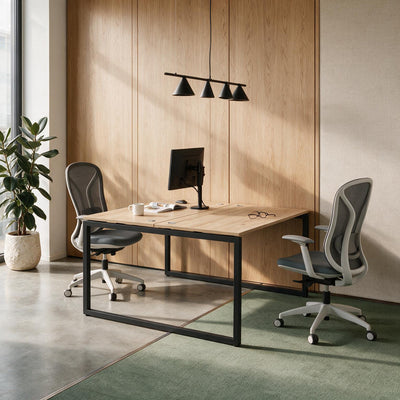
You work from home or in a corporate office and want a chair that looks as good as it performs. The Pro Flow is available in black and white, with a clean mesh profile that works in both a home office and a professional workspace. It doesn't look clinical. It looks considered.
You're equipping a team. The Pro Flow makes the most sense for corporate rollouts where long-hour professional use is the norm and value for money matters. For B2B enquiries and volume pricing, contact us directly.

Frequently asked questions
For most South African desk workers sitting 6–8 hours a day, yes. The Pro Flow offers 10-point adjustability, 4D armrests, full synchro recline with auto-tension, adjustable seat depth, and adjustable lumbar support, backed by a 7-year warranty. For people sitting 8–10 hours daily, the Axis Ergonomic Chair is the step up.
10-point adjustability means ten distinct ways to configure the chair to fit your body: seat height, seat depth, lumbar support height, recline angle, recline tension, recline lock position, armrest height, armrest width, armrest depth, and armrest angle.
Auto-tension automatically calibrates the resistance of the backrest to your body weight. Lighter users won't feel they're fighting the chair; heavier users won't feel the backrest has no resistance. The Humanscale ergonomic guide notes that self-adjusting recline mechanisms significantly reduce spinal disc pressure during use.
Yes. The Pro Flow is available in black and white with a professional build that suits both home office and corporate environments. The 7-year warranty and 125 kg weight rating make it appropriate for commercial use. Contact us for B2B and volume pricing.
Gaming chairs are designed primarily for aesthetics. The Pro Flow is designed around anthropometric research and postural science — with adjustable lumbar support, 4D armrests, a synchro recline that reduces spinal disc pressure, and a seat slider that prevents popliteal compression. For long hours at a desk, the difference is significant and cumulative.
The bottom line
The Pro Flow Ergonomic Chair earns its position as South Africa's best-selling ergonomic chair by doing what most people actually need: ten genuine points of adjustment, a synchro recline with auto-tension, 4D armrests, an adjustable seat slider, adjustable lumbar support, a breathable mesh back, and a 7-year warranty — all at a price that doesn't require a second mortgage.
It's the chair you set up once, dial into your body, and stop thinking about. Which is exactly what a good chair should be.


