





Do Standing Desks Actually Work? What the Research Says
Do standing desks actually work, or are they overhyped nonsense? We dug into the real research — the good studies and the inconvenient ones — to give you the honest answer. And it's more interesting than either side of the hype.

You've heard the pitch. Sitting is the new smoking. Stand up and you'll lose weight, fix your back, live longer, and possibly achieve enlightenment. You've also heard the backlash: standing desks are a scam, a wellness fad, an expensive way to get sore feet.
So which is it? Do standing desks actually work, or are they overhyped nonsense? We dug into the real research, the good studies and the inconvenient ones, to give you the honest answer. And the honest answer is more interesting than either side of the hype.
The short answer: yes, but not for the reasons you've been told
Let's not make you scroll. Here's the honest verdict up front:
Standing desks do work, but the benefits are narrower and more specific than the marketing claims. The strong evidence is for reducing discomfort and breaking up sedentary time. The weak-to-nonexistent evidence is for the big flashy claims: major weight loss, dramatically better heart health, turbocharged productivity.
And here's the part almost nobody tells you: whether a standing desk works for you depends almost entirely on how you use it. A standing desk you use correctly is a genuinely valuable health tool. A standing desk you leave at sitting height for eight hours is an expensive regular desk.
Let's get into what the science actually says, both the good and the disappointing.

Why standing desks became a thing in the first place
The whole standing desk movement is built on one genuinely alarming finding: prolonged sitting is bad for you.
This part is real and well-supported. According to the scoping review of sit-stand research published in Applied Ergonomics (Chambers, Robertson & Baker, 2019), people who sit 8 to 11 hours a day have a 15% higher risk of death over the following three years compared to those who sit under 4 hours. Office workers, who typically spend more than half their day seated, are squarely in the at-risk group. Excessive sitting has been linked to obesity, type 2 diabetes, cardiovascular disease, and more.
So the logic went: sitting is the problem, standing is the opposite of sitting, therefore standing desks are the solution. Simple, intuitive, and, as it turns out, only partly correct.

What the research says standing desks ACTUALLY do
Here's where we separate the proven from the oversold, using the actual data.
ProvenThey reduce discomfort
This is the strongest, most consistent finding. In that Applied Ergonomics scoping review of 53 studies, sit-stand desks were most effective in the discomfort domain, this is where they delivered their clearest wins. People using them reported less of the aching, stiffness, and musculoskeletal discomfort that comes with sitting frozen in one position all day.
Backing this up: a year-long study led by Mount Sinai researchers found that after 12 months with adjustable desks, 47% of users reported reduced back, shoulder, and neck discomfort. Nearly half. That's a genuinely meaningful real-world result.
There's even a specific mechanism for the back. One study in the review found that working in a sit-stand pattern was associated with reduced lumbar flexion during sitting compared to sitting alone, which suggests a real potential to ease low-back strain.
They change your behaviour (which is the real point)
The second-strongest finding: sit-stand desks actually get people to sit less. In the scoping review, 61% of behavioural results were significant, people using them reliably reduced sitting time and increased standing time.
Why does this matter more than it sounds? Because the health villain isn't sitting specifically, it's staying in any one static position for hours. The review is explicit: prolonged static postures, both sitting AND standing, are associated with poor health. The benefit of a sit-stand desk lies in its ability to break up those long static stretches. It's a movement tool, not a standing tool.
Weight loss and major metabolic benefits
Here's the disappointing one. That same scoping review found only 37% of physiological results were significant, and concluded that behaviour changes "only mildly effect health outcomes," with just "modest cardiometabolic health benefits."
Translation: you will not stand your way to weight loss. Standing burns marginally more calories than sitting, but nowhere near enough to matter for your waistline. If a standing desk is being sold to you as a fitness device, that's the hype talking.
Heart health
This is the finding the industry doesn't love. A large 2024 University of Sydney study of over 83,000 people, published in the International Journal of Epidemiology, found that standing more, over the long term, does not improve cardiovascular health (heart disease, stroke, heart failure). Worse, prolonged standing was associated with a higher risk of circulatory problems like varicose veins (reported by CNN).
This is exactly why "just stand all day instead" is bad advice. Swapping eight hours of sitting for eight hours of standing doesn't fix the problem, it trades one static posture for another and adds a fresh set of issues.
Productivity
If you're hoping a standing desk will make you a productivity machine, the evidence is lukewarm. The scoping review found only 7% of work-performance results were significant, the lowest of any category. Standing desks don't seem to hurt your work performance, but they don't dramatically boost it either.

The honest scorecard
| Claim | What the research says | Verdict |
|---|---|---|
| Reduces aches & discomfort | Most consistent benefit; 47% reported relief at 12 months | ✅ Proven |
| Reduces sitting / adds movement | 61% of behavioural results significant | ✅ Proven |
| Eases some back strain | Reduced lumbar flexion vs sitting alone | ✅ Promising |
| Weight loss / metabolic boost | Only "modest" effects; won't move the needle | ❌ Oversold |
| Better heart health | 2024 study: no benefit, possible circulatory risk | ❌ Oversold |
| Productivity boost | Only 7% of results significant | ➖ Neutral |
The pattern is clear. Standing desks are a comfort and movement tool, not a weight-loss or cardio device. Buy one for the right reasons and you won't be disappointed.
The real secret: it's not the desk, it's how you use it
Here's the thing the hype and the backlash both miss. Most people who say "standing desks don't work" used one badly. The desk isn't magic, it's a tool, and like any tool, it only works if you use it properly. Here's how to actually get the benefit.
1Alternate. Don't just stand.
This is the whole ballgame. The benefit comes from changing position, not from standing. Standing all day is as bad as sitting all day. Cornell University's Dr. Alan Hedge recommends a rhythm of roughly 16 minutes sitting, 8 minutes standing, and 2 minutes moving every half hour (via the Humanscale ergonomic guide). If you take one thing from this article: alternate.
2Actually change position (presets are your friend)
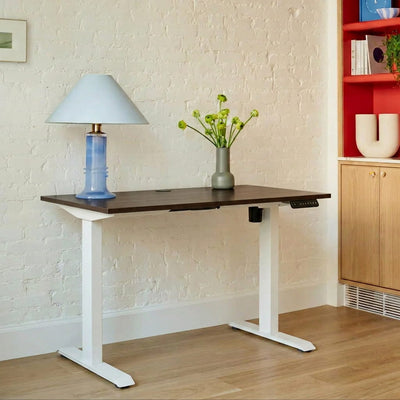
The single biggest reason standing desks fail is that people stop using the standing part. It's too much faff, so the desk lives at sitting height forever. This is exactly why an electric desk with programmable memory presets matters, you tap one button and it moves, removing the friction that kills the habit. If adjusting is effortless, you'll actually do it.
3Get the height right
When you're standing, your work surface should be at your resting elbow height, forearms roughly parallel to the floor, wrists straight. Too high and your shoulders shrug; too low and you hunch. Same principle when seated. A desk that's the wrong height is worse than useless.
4Sort out your monitor
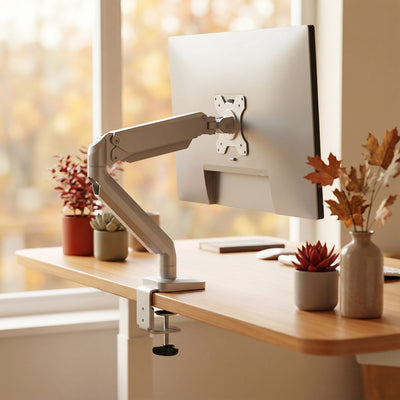
A standing desk doesn't fix your posture on its own, your screen has to come with you. The top of your monitor should be at or slightly below eye level whether you're sitting or standing. If you're staring down at a laptop on the desk surface while standing, you've just swapped back pain for neck pain. Get the screen up to eye level (a monitor arm or stand helps).
Get these four things right and a standing desk genuinely delivers. Get them wrong and it's a coat rack that cost you a few thousand rand. For the full setup, see our complete ergonomic home office guide.

So, should you buy one? And where?
If you sit for long hours and you want to reduce the aches and break up the sedentary grind, yes, a standing desk is a genuinely worthwhile tool, provided you commit to using it properly. If you're expecting it to melt fat or fix your heart, save your money and go for a walk instead (which, honestly, the research likes a lot more).
If you've decided it's worth it, the two things that matter most are effortless adjustment (so you actually use it) and the right height range for your body.
In South Africa, our best-selling Sit-Stand Desk Pro (from R13,100) and the robust Pro Lift (from R12,100) are both dual-motor electric desks with programmable presets, exactly the effortless adjustment that makes the habit stick. If you want to test the waters without the electric price tag, the manual QuickStand (from R4,347) gets you into sit-stand for less, just know you'll be adjusting by hand.
Not sure what fits your space, height, and budget? Take our quick Find Your Fit quiz, or browse the full standing desk range. And if you want to talk it through, get in touch, we'll give you an honest recommendation, even if that's the cheaper desk.

Frequently asked questions
Yes, but for specific benefits. The strongest research evidence is that standing desks reduce musculoskeletal discomfort and successfully reduce sitting time by encouraging movement. A scoping review of 53 studies in Applied Ergonomics found sit-stand desks were most effective in the discomfort domain, and a separate year-long study found 47% of users reported reduced back, shoulder, and neck discomfort. However, the evidence does not support big claims about weight loss or improved heart health. Standing desks work as a comfort and movement tool, not as a fitness or cardiovascular device, and the benefit depends heavily on using them correctly by alternating between sitting and standing.
For people who sit long hours and want to reduce aches and break up sedentary time, yes, a standing desk is worth it, provided you commit to alternating positions rather than either sitting or standing all day. It's not worth it if you're expecting significant weight loss or heart-health benefits, which the research doesn't support. The value comes down to correct use: alternating sitting and standing, setting the right height, and keeping your monitor at eye level. Used properly, it's a worthwhile ergonomic investment; left at one height all day, it's just an expensive desk.
No. Prolonged standing is not a healthy substitute for prolonged sitting. A 2024 University of Sydney study of over 83,000 people found that standing more did not improve cardiovascular health and prolonged standing was associated with a higher risk of circulatory problems such as varicose veins. Both sitting and standing are static postures, and staying in either for hours is associated with poor health. The benefit of a sit-stand desk comes from regularly alternating between the two, not from replacing sitting with standing.
Research doesn't pin down one perfect ratio, but a widely cited guideline from Cornell University's Dr. Alan Hedge recommends roughly 16 minutes sitting, 8 minutes standing, and 2 minutes moving every half hour. The key principle is to avoid staying in any single position for too long. Start with shorter standing periods (15–30 minutes at a time) and build up, and prioritise frequent position changes over long standing stretches, since prolonged standing carries its own downsides.
They can help. A scoping review in Applied Ergonomics found discomfort reduction was the most consistent benefit of sit-stand desks, and one study found that a sit-stand pattern was associated with reduced lumbar flexion compared to sitting alone, suggesting potential relief of low-back strain. A separate year-long study found 47% of users reported reduced back, shoulder, and neck discomfort. That said, a standing desk works best for back pain as part of a broader setup that includes a supportive chair, correct monitor height, and regular movement, not as a standalone fix.
Workspace Dreams supplies a full range of sit-stand desks in South Africa, from the manual QuickStand (from R4,347) to dual-motor electric models like the Pro Lift (from R12,100) and the best-selling Sit-Stand Desk Pro (from R13,100), which include programmable height presets for effortless adjustment. When choosing, prioritise a desk with easy adjustment (so you actually use the standing function) and the correct height range for your body. All Workspace Dreams desks include free or flat-rate nationwide delivery, and a quick online quiz can match you to the right one.
The bottom line
Do standing desks work? Yes, honestly, but only if you understand what you're buying. They're not weight-loss machines or heart-health miracles, and anyone selling them that way is overreaching past the evidence. What they genuinely do, and the research is solid here, is reduce the aches of desk work and break up the long static stretches that make sitting harmful in the first place.
But the desk is just a tool. The results come from how you use it: alternating between sitting and standing, keeping the height right, getting your monitor to eye level, and actually pressing the button to change position throughout the day. Do that, and a standing desk earns its place. Ignore that, and it's furniture.
Bought for the right reasons and used properly, it's one of the better upgrades a desk worker can make. Just don't expect it to do your exercise for you.


