





How to Choose an Executive Office Desk in South Africa
Most people buy an executive desk the way they buy a fridge. They look at pictures, pick the one that looks right, and discover the problems later. Except a fridge gets replaced in eight years and nobody has to sit at it for two thousand hours a year.
An executive office desk in South Africa will typically run you somewhere north of R10,000, and you will likely keep it for a decade. That is long enough for every compromise to become a daily irritation. This guide covers the six things that actually determine whether you will still be happy with the desk in year three.

Start with the room, not the desk
The most common executive desk mistake is buying the desk you want for a room that cannot take it.
Before you look at a single product, measure the room. Then subtract. You need roughly 900mm to 1000mm of clear space behind the desk for the chair to move, and a person to get in and out without shuffling sideways. If the desk sits against a wall, you need less. If it floats in the room with a credenza behind it, you need that clearance on both sides.
Measure the door too. A 2000mm desktop does not always fit through a 900mm doorway at an angle, and while most executive desks arrive as components rather than a single slab, it is worth checking before delivery day rather than during it.
Write down three numbers: room width, room depth, and doorway width. Everything else follows from those.

Sizing: what the numbers actually mean
Executive desk dimensions are usually quoted as width x depth x height, in millimetres.
Height is the easy one. Most executive desks sit at 720mm to 750mm. That is a standard fixed height, and it is worth understanding what that means for your body. Standard desk heights suit a fairly narrow band of people. The reference point that matters is your resting elbow height: the work surface should sit at roughly the same level as your elbow when your shoulders are relaxed and your forearms are parallel to the floor.
If a fixed-height desk sits too high for you, the fix is to raise your chair and add a footrest, rather than shrugging your shoulders up to meet the desk for eight hours. If it sits too low, desk risers can lift it. Either way, the chair does the fine adjustment, which is why the chair matters at least as much as the desk.
Width and depth determine whether the desk works. For a single monitor, a keyboard and space to write, 1500mm of width is workable. For dual monitors, a laptop docked alongside, and room to spread documents, 1800mm is the realistic minimum, and 2000mm is comfortable.
Depth matters more than most buyers expect. You want your monitor at roughly arm's length, which is around 500mm to 750mm from your eyes. A shallow desk forces the screen too close, and the usual result is leaning back or squinting. A depth of 750mm or more gives you that distance without compromise.
L-shaped desks are quoted differently, because the return counts. A desk listed as 1800 x 1800 has a 1800mm main surface and a 1800mm return, forming the L. That second surface is not just extra space. It is a second working zone.

L-shaped or straight: an honest comparison
There is no universally better answer here. There is a better answer for how you work.
An L-shaped desk earns its space when
You regularly switch between two modes of work. Screen work on the main surface, paperwork or a second screen on the return. It also suits corner placement, which frees up the rest of the room, and it gives you a natural separation between the thing you are doing now and the things waiting.
A straight desk is better when
The room is tight, when you want the desk to float in the middle of the room facing the door, or when you genuinely only ever do one thing at a time on one screen. A straight desk with a separate credenza behind it is a classic executive layout for a reason, and it often reads as more formal than an L.
L-shaped desks are handed. A left-hand return and a right-hand return are different products, not a setting you change later. Work out which side you want the return on by sitting in the room and thinking about where the door and window are. You generally want the return on your non-dominant side, and you generally do not want your back to the door.
Surface material: read the millimetres
This is where price differences usually live, and where the specification sheet tells you more than the photograph.
Most quality executive desks in this price bracket use a melamine-faced board top. The number to look for is thickness. A 32mm top is substantially more rigid than the 18mm or 25mm boards used in lighter commercial furniture. It resists sagging across a long unsupported span, it takes an edge impact without denting, and it simply feels more solid under your forearms.
Solid timber tops exist and are beautiful, but they cost considerably more, they move with humidity, and they need maintenance. For most South African offices, a well-made 32mm melamine top on a properly engineered frame is the sensible specification.
Look at the frame too. Panel legs, where the desk is supported by full-height side panels rather than metal legs, add rigidity and give the desk a more substantial presence. Metal-frame desks are lighter and easier to move but can develop a slight wobble over years of use.

Storage: lockable matters more than you think
An executive desk usually needs storage attached to it, and the deciding feature is whether it locks.
If you handle contracts, HR files, financials, or anything covered by POPIA, a lockable pedestal is not a luxury feature. It is the difference between a compliant document handling process and a stack of paper on an open shelf. Even in a private office, cleaning staff and after-hours access are realities.
A standard pedestal gives you two shallow drawers for stationery and one deep filing drawer. That deep drawer is the one that matters, because it takes suspension files, and suspension files are what stop paperwork migrating onto your desktop.
The other storage question is cable management. Built-in cable ports through the desktop sound like a minor detail until you have a laptop, two monitors, a dock, a phone charger and a desk lamp all needing power. Without ports, the cables run over the back edge of the desk, and no executive desk looks executive with a bundle of cables draped down the back of it.
Two executive desks compared
Here is how two of our own desks differ, and who each one suits. Both are made to order, so lead time applies. We will confirm it in writing with your quote.
| The L Shaped Desk | The Corner Office Executive Desk | |
|---|---|---|
| Starting from | R13,400 | R13,563 |
| Top thickness | 32mm | 32mm melamine |
| Layout | L-shaped with integrated side storage | L-shaped, left or right hand |
| Sizes | Enquire for dimensions | 1800 x 1800 x 750 or 2000 x 1800 x 750 |
| Lockable pedestal | Not specified | Yes |
| Cable ports | Not specified | Yes, built in |
| Finish options | Four: Oak and White, Mondego Elm and Light Grey, Marmara Walnut and Folkstone Grey, Leander and White | Three-tone: customise top, drawers and legs |
| Best suited to | A warmer, more residential executive look with strong finish choices | A working executive office where security and cable management matter |
The L Shaped Desk leads on finish. Four combinations, including a genuine oak-look top and two darker wood tones, which suit an office where the desk is part of the room's character rather than pure equipment. The 32mm top and panel-leg construction give it a solid, grounded feel. Integrated side storage keeps essentials within reach.

The Corner Office Executive Desk is the more specified of the two. You choose your size, 1800mm or 2000mm main surface, and your handedness, left or right return. The lockable pedestal and built-in cable ports address the two problems most executive desks ignore. The three-tone system lets you specify the top, the drawers and the legs separately, which is useful when matching existing office furniture.

Choose the L Shaped Desk if the look of the room is the priority and you want a defined set of handsome finishes. Choose the Corner Office if you need the desk to work hard, lock things away, and manage a real cable load.
Browse the full range of executive desks and office desks.
The chair is half the purchase
A quick but important note, because we see this constantly.
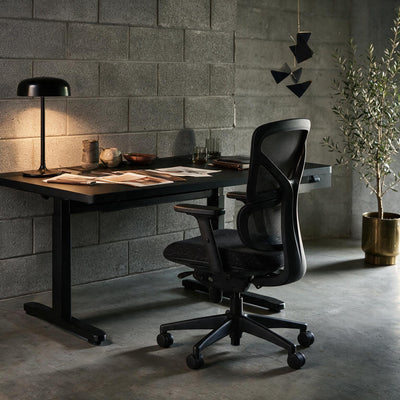
People spend R13,000 on an executive desk and R2,000 on the chair, then wonder why their back hurts. It is the wrong way round. The desk is a fixed surface. The chair is the thing that adapts to your body, supports your spine, and moves with you through the day.
A fixed-height desk in particular puts more work on the chair, because the chair is now doing all the height adjustment. Seat height, seat depth, lumbar support and armrest height all need to adjust, and the armrests need to align with your elbows so your shoulders can stay relaxed.
If you are specifying an executive office, budget for the chair properly.
Executive Office Chairs Ergonomic Office Chairs Take The Find Your Fit QuizFrequently asked questions
What is a standard executive office desk size in South Africa?
Executive desks typically range from 1500mm to 2000mm wide, 750mm to 900mm deep, and 720mm to 750mm high. L-shaped executive desks are quoted with both surfaces, so 1800 x 1800 means an 1800mm main desk with an 1800mm return. For dual monitors and paperwork, 1800mm width is the practical minimum and 2000mm is comfortable.
How much does an executive office desk cost in South Africa?
Prices vary widely by construction and specification. Workspace Dreams executive desks start from R13,400, with the Corner Office Executive Desk from R13,563 for the 1800mm size and R13,741 for the 2000mm. Below roughly R8,000 you are generally looking at thinner tops and lighter frames. Imported premium executive desking runs well above this range.
What thickness should an executive desk top be?
A 32mm top is the benchmark for executive desking. It resists sagging over long unsupported spans and handles daily impact better than the 18mm or 25mm boards common in lighter office furniture. Both Workspace Dreams executive desks use a 32mm top.
Should I choose a left-hand or right-hand L-shaped desk?
L-shaped desks are handed and cannot be switched after purchase. Sit in the room first. Most people put the return on their non-dominant side so the main surface stays clear for writing, and position the desk so they are not sitting with their back to the door. Window position matters too: side light is better than light directly behind or in front of your screen.
Do executive desks come with locking drawers?
Not always, so check the specification. The Corner Office Executive Desk includes a lockable pedestal. If you handle contracts, HR records, financial documents or any personal information covered by POPIA, a lockable drawer should be treated as a requirement rather than an upgrade.
How long does an executive desk take to arrive?
Our executive desks are made to order rather than held in stock, so lead time depends on the finish and size you specify. We confirm the lead time in writing with your quote before you commit, rather than giving an estimate on the phone.
Before you buy: a short checklist
- Measure the room, the clearance behind the desk, and the doorway.
- Decide L-shaped or straight based on how you actually work, not how the photo looks.
- Check the top thickness is 32mm.
- Decide which side the return goes on.
- Confirm whether the pedestal locks.
- Check for cable ports.
- Budget for the chair as a serious line item, not an afterthought.
Get those seven things right and the desk will still be working for you in ten years.
Not sure which desk suits your space? We will confirm sizing, finishes and lead time in writing.
Contact Us For A Quote


